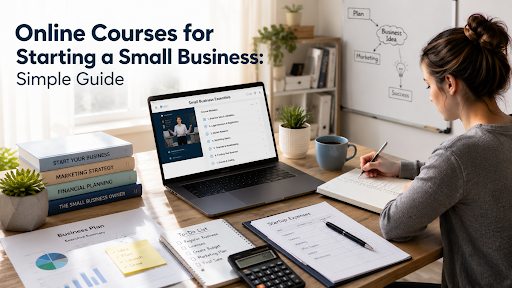
Dana quit her job at a marketing agency last spring. Opened a plant shop out of her garage. She had a good eye for arranging succulents. That’s about it, honestly. No clue how to price inventory, no idea how to register a business name, and she’d never once looked at a profit and loss statement in her life. Her uncle told her to just “figure it out as she went.” Which is exactly what he did with his hardware store, and it folded within three years. So she didn’t do that. Spent two weekends buried in online courses for starting a small business, took notes on actual paper like it was 2004, and caught at least three mistakes before she ever unlocked the front door. Not because the courses were magic. Because she finally knew what questions to ask. This is really all these courses are good for. They don’t replace doing the work. They just get you past the part where you don’t even know what you’re supposed to be worried about yet. Most people learn this stuff the slow way, two rough years of guessing. A few good courses, actually finished, can knock that down to a few weeks. Why Most Course Lists Don’t Actually Help Go search for this topic right now. You’ll get lists with a hundred, sometimes three hundred, courses stacked one after another with no real explanation of who any of them are for. It’s exhausting. Nobody starting a business needs a hundred options. They need three, maybe four, that actually hit whatever they’re weak at. So figure out your gap first. Genuinely, sit with it for five minutes. Can you sell but not read a balance sheet? Look for a small business management course. Good with numbers but freeze the second marketing comes up? Entrepreneurship courses online, the ones built around getting your first ten customers, not the ones full of theory you’ll forget by Friday afternoon. There’s a legal piece too, and it’s the one everyone wants to skip. Registering your business name. Picking a structure, LLC or sole proprietorship or whatever fits. Figuring out which licenses your state actually wants from you, because it’s never the same list twice. Boring stuff. But skip it and you’re the one explaining a tax mess to someone a year from now, wishing you’d spent the two hours. Skills Worth Learning Before You Launch A few skills show up over and over no matter what you’re selling. Bookkeeping’s the big one. Not accounting, just enough to answer one honest question: are you actually making money, or does it just feel like you are because cash is moving around? A lot of owners can’t answer that after a full year in business. That’s not a knock on them. Nobody taught them how. Pricing trips people up constantly. Dana priced her first batch too low and forgot to count her own labor entirely, basically paying herself in exposure for a month. A decent how-to-start-a-small-business-online course covers cost-plus pricing in maybe twenty minutes. Then marketing. Not ads, not yet. Just knowing who your customer is, where they actually spend their time online, and why they’d pick you over the place two doors down. LearnVaultPro’s entrepreneurship courses cover this in one short module, the kind you knock out on a lunch break, which honestly beats the tired advice of “just post more on social media” that everyone’s sick of hearing. Free vs. Paid: What’s Actually Worth Paying For Free can absolutely teach you the basics. The Small Business Administration has a step-by-step guide, registration, licenses, funding, the whole starting-line checklist. Doesn’t cost a thing. Reads like a government pamphlet because, well, it is one. Dry as toast. Every word of it checks out, though, and that matters more than being entertained when you’re deciding how to structure a business. Paid courses earn their keep with one thing free ones almost never have: feedback. Any list of the best online courses for small business owners worth reading will point you toward something with real instructor access or a community you can ask questions in, not just a stack of pre-recorded videos. That’s worth money in your first few months, when you genuinely don’t know what you don’t know yet. Dana said the community forum inside her course helped more than the lessons themselves, mostly because she could type “is this normal?” at 11 p.m. and get an actual answer from someone three months ahead of her. SCORE, backed by the SBA, pairs new owners with free mentors too. Sometimes that one conversation with a real person beats an entire course. LearnVaultPro built its small business startup course around exactly this gap. Structured lessons for the fundamentals, plus a way to ask a real question when your situation doesn’t match whatever the textbook example assumed. Getting Started This Week Pick one gap. Not five. One. Spend a real week on it, not twenty scattered minutes between other things. Dana didn’t take every course sitting on that hundred-course list. She took two. Finished both. Actually used what she learned before she let herself move to the next thing. A year in, she’s still open, still figuring pieces out as she goes, sure, but open. That’s more than a lot of people who spent that same year “researching” can say. And here’s the part the course descriptions never mention. No course replaces it actually starting. People collect certificates for a year straight and never unlock their front door, because learning feels safer than doing. It just does. Courses shrink the learning curve. They don’t stand in for the part where you put something out into the world and find out, for real, whether it works. Want the fuller path instead of stitching courses together yourself? LearnVaultPro’s full course library covers registration straight through your first year of marketing, built for people starting from exactly zero. The U.S. Chamber of Commerce has free startup resources too, worth bookmarking next to whatever course you

Best Content Strategy Course Online for 2026
You’ve been writing blog posts, social captions, and maybe a newsletter for a while now. It’s fine. Traffic trickles in. Nothing much changes. At some point you figure out the real problem. It was never your writing. Nobody ever taught you how to plan content. They only taught you how to make it. That’s the gap a content strategy course online is supposed to close. It’s also where people waste money picking the wrong one. Honestly, this whole space is a mess right now. Search “content strategy course online.” You’ll see university certificates. You’ll see $19 courses. You’ll see an agency’s own paid program. That program always seems to rank first on the agency’s own blog post about the “best” courses. Funny how that works. Some of what’s out there is genuinely good. A lot of it is just a thirty-minute video behind a fancy landing page. It’s held up by a wall of glowing reviews. So here’s how I’d pick one. I’ll cover the 2026 options worth your time, plus a few traps to watch for. How to Choose a Content Strategy Course A lot of courses called “content strategy” are teaching something else. They’re really content marketing courses with a new title. They spend most of their time on posting schedules and hashtags. They barely touch why you’re making the content in the first place. Look at what’s inside before you look at who’s teaching it. A real content strategy course covers a few key things. It covers audience research. It covers content audits. It covers site structure. And it covers how to connect content to a real business goal, not just clicks or likes. Does the course jump straight into “how to write viral hooks” without ever asking who the content is for? That’s a content creation course wearing a strategy costume. Next, check who built it. People who’ve run content strategy at a real company tend to teach it better than people who’ve just written about it online. Ask for the syllabus before you pay. If a sales page is full of testimonials but light on an actual week-by-week plan, that tells you something too. Price trips people up more than it should. I’ve seen a free course beat a $400 course. The free one had real structure. The pricey one just looked nice. Match the course to the gap you actually have, not to the price tag. Check the date as well. Content strategy hasn’t changed as fast as, say, AI tools have. But an old course still using a content calendar template from 2019 will feel out of date fast. It’ll mention a platform nobody uses anymore. No update date listed on the course page? That usually means nobody’s touched it in years. Don’t want to dig through course pages yourself? LearnVaultPro’s course directory sorts marketing courses by skill level and price, so you don’t have to. Best Free Content Strategy Courses Online Free doesn’t mean sloppy. Some of the best options for learning the basics only charge if you want a certificate at the end. HubSpot Academy’s content marketing certification is free. It takes a few hours.It kicks off with strategy actual business goals, not just “post more content” before it ever gets into production or promotion. It’s built for beginners, so if you already know the basics, it might feel slow. As a first course, though, it holds up. Google’s Digital Garage has a free intro unit on content strategy. It sits inside a bigger digital marketing course. It’s shorter and more bare-bones than HubSpot’s version. Fine as a starting point, honestly, if all you want right now is the vocabulary down. Coursera’s got university-built content strategy modules too, and you can audit those for free. That means you get the lectures and materials, just not the graded work or the certificate. Northwestern’s content strategy material, part of a larger marketing program, is a good example. You skip the certificate. You don’t skip the actual learning. Want a real free content strategy course that won’t try to upsell you three lessons in? Start with those three. Best Paid Content Strategy Certification Online Sometimes free only gets you halfway. Paying for structure, feedback, or a certificate that actually means something can be worth it. The Content Marketing Institute’s paid courses go deeper than most free ones. These come from people who’ve spent actual years publishing research on this, not just packaging up someone else’s ideas. Budget $200 to $500 for it. . The price depends on the course. Mostly, you’re paying for real tools, like content audit templates and editorial calendars, not just more definitions. University programs, like Northwestern’s content strategy course through Coursera, let you audit for free. You only pay, usually around $49 a month, once you decide you want the certificate. It’s a low-risk way to test it out before spending real money. Smaller agency-run courses are hit or miss. Prices run anywhere from $150 to well over $1,000, depending on how much live coaching is included. Some are great, taught by people who do this work for real clients every week. Others mostly exist to sell you a consulting package once the course ends. Read a few reviews that aren’t sitting on the sales page before you pay. Content Marketing Strategy Course vs. Content Strategy Course These two get mixed up in course titles all the time, and it causes more confusion than it should. A content marketing strategy course is usually about distribution. Which channels to use, how to promote what you’ve made, how to grow an audience. A content strategy course, in the stricter sense, comes earlier in the process. It’s about figuring out what to make in the first place, who it’s for, and why it matters to the business. Both are worth taking. Just know which one you’re signing up for. Someone who already understands distribution and just needs help with planning will get bored fast. Four modules on scheduling tools won’t hold their