My friend Priya started making lattes in the middle of 2019. She had no design degree, no internships, no tech community connections, nothing. She used her only available resource to learn UX design – her late-night hours in the designer chair with a hot cup of tea and her own personal motivation. Priya spent her free time redesigning her disliked applications to challenge herself in order to feel proud that she was able to improve them. Now, Priya has a junior UX designer position in a healthcare start-up So here’s the actual answer to how to become a UX designer with no experience: you learn the skills, and then you prove it, in that order. A diploma isn’t what gets you hired. A portfolio that shows you understand how people actually use things is what gets you hired. Companies really don’t care as much about your background as you’d think. Start With the Basics of UX Design Don’t touch Figma yet. First of all, familiarize yourself with the field you want to work in – it is vital to be aware of the difference between general and UX/UI design. UX/UI is a process of researching what a user needs and building an experience around it, not the art of making things pretty. Research first. Then wireframes. Then testing, which usually proves your first idea was wrong, and then you do the whole loop again. You don’t need to spend twelve grand on a bootcamp for this stage. Google’s UX Design Certificate on Coursera is cheap, and it’s respected, so it’s a fine place to start. Nielsen Norman Group also publishes some genuinely excellent UX writing, and a lot of it costs nothing. Give yourself maybe four to six weeks here, no longer than that. This part is mostly vocabulary personas, information architecture, usability testing, and wireframes. It’ll feel a little dry and theoretical for a while. Push through it anyway. You’ll hear these words in every interview you sit through later. Learn the Tools Real Designers Use Knowing the theory won’t land you a job by itself. At some point you actually have to build things. Figma is what most teams use now, and it’s free to start, so there’s really no reason to keep watching tutorial after tutorial without opening the app yourself. Adobe XD and Sketch show up in a job posting here and there, but Figma will cover you for years. Just pick it. Get a little uncomfortable in it for a few weeks and keep going. I’ve seen plenty of beginners waste three months hopping between five different tools because committing to one felt scary. That’s one of the more common traps people fall into with how to become a UX designer with no experience mistaking tool-hopping for actual progress. Build a UX Design Portfolio for Beginners This is the piece that actually gets you hired. Not the resume. Not a certificate hanging on LinkedIn. The portfolio. Also, prepare three or four projects – no more, no less. Avoid those “redesigning Spotify application” clichés that recruiters saw a billion times before. Find something smaller and stranger instead. A nonprofit’s donation page with a checkout flow nobody can finish. The scheduling app your dentist’s office uses that every patient in the waiting room complains about. Even today, I know cafes that use paper tickets stapled together as their billing system. for every project, demonstrate your process, not just the pretty mockups. What was actually broken? Who’d you talk to? What did you try that completely failed before something finally clicked? publish it somewhere online, preferably on Behance or a simple website built with Framer. Three projects will look better than ten half-done ones, and one failed case analyzed with attention to detail can be more useful than a successful project. Second, practice with real problems, not only with tutorials. Tutorials teach you exactly what to do; projects teach you how to make judicious decisions, which is a much-needed skill in almost every position, including UX design. Once you become familiar with Figma, stop watching the YouTube videos about UX design and begin creating your own projects. Practice on Real Projects, Not Just Tutorials Choose one particular topic, do a bit of research on it on your own, and interview at least five individuals regarding their experience with the given product to develop your own project based on the results of the interviews, detailing all steps taken. Although it is not an actual client, this will be close enough to real practice. Third, look for feedback from the UX design community as much as possible. Offer to redesign something for a local nonprofit, a small business nearby, or a friend’s side hustle running on a website nobody can navigate. It counts as real experience because there’s an actual person involved, with actual constraints and actual opinions about their own business, which is messier and far more useful than a made-up brief. That mess is exactly what proves you’ve figured out how to become a UX designer with no experience in a market stuffed with people holding design degrees and not much else.No client lined up yet? Get Feedback From the UX Design Community ADPList connects you with mentors for free calls. Most cities, even smaller ones, have a Meetup group for design somewhere. And design Discord servers are full of people who’ll tear your work apart if you actually ask them to, which is what you want, even if it stings a bit reading it. Learn Vault Pro folds that feedback loop directly into its beginner tracks alongside the skill-building itself, so you’re not left guessing what to work on next. Feedback stings, plain and simple. Take it anyway.I would rather show my disorganized progress on the second week than a perfect project on sixth month because after six months of staring at my own work, I will not be able to see the flaws in my process. Apply for Entry-Level UX Design Jobs Many entry-level UX
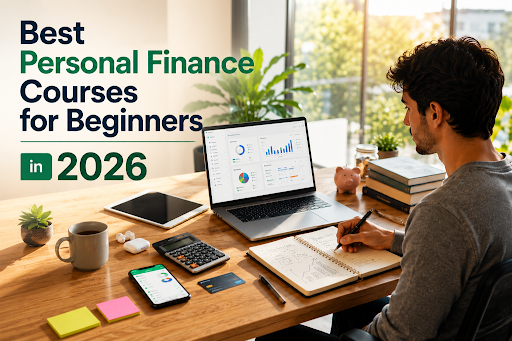
Best Personal Finance Courses for Beginners in 2026
You just got your first real paycheck. Or maybe your fifth, and you still open your banking app and feel a little sick. What’s a Roth IRA? Why did your credit score drop for no reason? Where does the money actually go every month? Nobody’s born knowing this stuff, and most schools never bother teaching it. So people learn the hard way, usually right after they’ve already made the expensive mistake. A decent course can shortcut all that. Not a stack of forty-five-second videos, an actual course with a start and an end. The trouble is picking one that teaches you something instead of funneling you toward an affiliate link. Here’s the complete guide about the criteria to look for best personal finance courses for beginners 2026 that will appear in 2026 and how to navigate through numerous options while searching for a course that will deliver results in attaining needed improvements. Choosing the Best Personal Finance Course How to Choose a Personal Finance Course Courses are different; the bright and attractive webpage does not guarantee the quality of the course contents. Start with who’s teaching it. A course built by a university or a certified financial planner carries more weight than one from someone with no credentials and a flashy sales page. Then check what’s actually inside. An introductory course includes lessons on budgeting, savings, use of credit, debt as well as basics of investing in the given order. If an introductory course doesn’t cover the basics of investing and jumps straight into options trading or the latest cryptocurrency craze, it probably requires some market knowledge as it is tailored to advanced students. Before enrolling into a course, be sure to read several reviews on it, avoiding those that are overly enthusiastic and tell how inspiring the instructor is. Cost matters too, but not the way people assume. Plenty of free courses are excellent. Some paid ones earn their price through structure and real feedback. Match the price to what you need, not the other way around. If you’d rather skip the guesswork, LearnVaultPro sorts course options by skill level and budget, which saves you from opening fifteen browser tabs. Best Free Personal Finance Courses Online Free doesn’t mean thrown together. Some of the strongest personal finance basics for young adults come from platforms that only charge for a certificate at the end. The course itself costs nothing. Coursera’s Fundamentals of Personal Finance series was built by certified financial planners and split into five courses covering budgeting, saving, debt, and investing. You can audit the whole thing without paying a cent and only pull out your card if you want proof you finished. The Open University’s OpenLearn platform has a similar option built specifically for people making their first independent money decisions. It runs about 24 hours total, leans on real scenarios instead of dry theory, and that’s probably why people actually finish it instead of abandoning it in week two. If your main goal is tracking down free personal finance courses online without any strings attached, start with these two. They are reliable, they are trustworthy, and your money stays intact. Best Paid Courses Worth the Investment It is sometimes worthwhile to spend a little more money to gain structure and receive faster feedback with an accredited certificate that adds value to your CV. Udemy’s personal finance courses usually run somewhere between $100 and $150 and come with lifetime access plus downloadable worksheets. They move quicker than the free university options, which helps if you’ve already got the basics down and want to go deeper into investing or insurance without sitting through the 101 material again. University-backed programs, like the one from the University of Florida on Coursera, let you audit for free and only pay if you want the certificate track. That’s a nice safety net. Try it first, decide if it’s worth paying for later. Money Management Courses for Beginners Budgeting and saving only get you halfway there. The better money management courses for beginners also cover how to deal with debt without spiraling, how your credit score actually gets calculated, and how to set goals that survive past the second week of January. A good course explains the difference between debt that’s working for you and debt that’s working against you, instead of just saying debt is bad. It elaborates the components of your credit score, making this figure less mystical. It also helps you create a plan that you can afford and not one that is tailored for someone making two times your salary. If the course does not cover this but gets straight to how you can become rich quickly, close it immediately. Budgeting Courses for Beginners If your problem is budgeting, find a course that focuses on it. The best budgeting courses for beginners teach you an uncomplicated method like the 50/30/20 rule, and make you able to modify it as soon as you understand it. Look for courses with real templates or trackers built in, not just an hour of someone talking at a whiteboard. Watching a lecture on budgeting teaches you a lot less than building one yourself with guidance along the way. Some of the better-reviewed best personal finance courses for beginners 2026 options pair short videos with hands-on worksheets for exactly that reason. Getting the Most Out of Your Course Finishing a course doesn’t fix your finances by itself. The value shows up when you actually use what you learned, ideally the same week you learn it. Open a budgeting app or a plain spreadsheet before you’ve even finished the first module.Choose one particular goal; for instance, starting an emergency fund of $500 is a good start since it gives you something specific to focus on instead of leaving it as a mere intention. A few months down the line, go over that material again since acquiring money skills takes time. For a side-by-side look at course options based on your goals and budget, LearnVaultPro’s course guide